


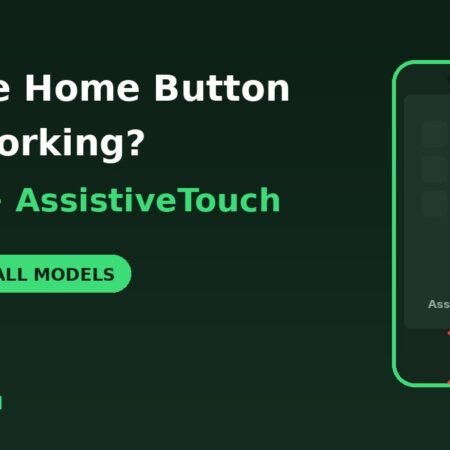

Quick Answer: First, get yourself unstuck: turn on AssistiveTouch (Settings → Accessibility → Touch → AssistiveTouch) for an on-screen Home button that works instantly — ask Siri to “open Accessibility settings” if you can’t navigate. Then try the real fixes: remove the case and clean around the button (grime and tight cases are the top cause), restart the iPhone, and try the well-known “recalibration” trick — open a stock app, hold the Power button until the slider appears, then hold the Home button until the slider disappears. If the button is fully dead after a drop, it’s the flex cable, and that’s a repair.
The Home button stops working and suddenly your iPhone feels like a puzzle box — you can’t leave apps, Touch ID fails, and every task takes twice as long. Sometimes it’s completely dead, sometimes it works one press in three, which is arguably worse.
The good news is that plenty of Home button failures are software or grime, not broken hardware — and even when it is hardware, iOS has a built-in replacement that costs nothing. This guide does both jobs: it gets you navigating again in thirty seconds, then works through nine fixes from the free and easy to the honest hardware answer.
Diagnose It First
| Symptom | Most Likely Cause | Jump to Fix |
|---|---|---|
| Works sometimes, fails others | Grime, case pressure, or failing cable | Fix 2 & 3 |
| Stopped after installing a case/protector | Physical interference | Fix 2 |
| Stopped after an iOS update | Software glitch | Fix 3, 4 & 6 |
| Button clicks but nothing happens | Software or connector issue | Fix 4 & 5 |
| Touch ID also failing consistently | Leans hardware | See “When It’s Hardware” |
| Stopped after a drop or water | Flex cable damage | See “When It’s Hardware” |
How to Fix an iPhone Home Button
Fix 1: Turn On AssistiveTouch — Your Instant Workaround
Do this first, whatever the cause. It puts a floating on-screen button on your display that does everything the physical one does — and it works even if the hardware is completely dead.
- Settings → Accessibility → Touch → AssistiveTouch → toggle on. A small dark circle appears on screen.
- Can’t reach Settings without a Home button? Ask Siri: “Turn on AssistiveTouch” — she can do it directly.
- Tap the circle → Home to go to the Home screen; double-tap for the app switcher.
- Streamline it: Customize Top Level Menu → reduce it to a single “Home” icon, so one tap does the job with no menu. You can drag the button to any screen edge.
Fix 2: Remove the Case and Clean Around the Button
The most common physical cause, and completely free to rule out.
- Take off the case and any screen protector — tight or misaligned ones press the button constantly or block its travel.
- Look closely at the button’s edge for grime, pocket lint, or dried residue. Clean gently with a dry soft cloth or a soft dry toothbrush around the rim.
- Avoid liquids, and never poke around the edge with metal — you’ll turn a sticky button into a dead one.
- Test again with the case off before putting it back.
Fix 3: Restart the iPhone
A crashed background process can stop the system responding to button presses even when the hardware is fine.
- Power off fully, wait 30 seconds, power on.
- Test the button several times before judging — intermittent behaviour needs more than one press to assess.
Fix 4: The “Recalibration” Trick
Unofficial, undocumented, and oddly effective — widely reported to revive unresponsive Home buttons regardless of cause.
- Open a stock Apple app (Clock, Weather, Calculator).
- Hold the Power/Side button until “slide to power off” appears — don’t slide it.
- Now hold the Home button until the slider disappears and you’re returned to the Home screen.
- Test the button. Many people find it responsive again immediately.
Fix 5: The Connector Reseat Trick
Another community fix — the theory is that it settles a slightly loose connector inside. It’s gentle and harmless if done carefully.
- Plug the charging cable into the iPhone.
- Apply light pressure to the connector, pushing it gently towards the screen (not hard — no force).
- While holding it, press the Home button a few times, then unplug and test.
- If pressing near the connector temporarily fixes the button, that points to a loose internal connection — worth mentioning to a repair technician.
Fix 6: Update iOS
- Settings → General → Software Update — button-response bugs have appeared and been patched in point releases.
- Restart after updating and test.
Fix 7: Check Accessibility Settings That Change Button Behaviour
Some settings make a working button feel broken.
- Settings → Accessibility → Home Button (on models that have one): check the click speed setting — set to Slow or Slowest, presses register differently than you expect.
- Same screen: Rest Finger to Open — with it on, you don’t need to press at all, which some people interpret as the button “not working”.
- Accessibility → Touch → check Touch Accommodations isn’t set to require an unusually long hold.
Fix 8: Free Up Storage and Close Apps
A phone starved of resources responds sluggishly to everything, including buttons.
- Settings → General → iPhone Storage — free up a few GB if it’s nearly full. Our iPhone storage guide helps if there’s “nothing to delete”.
- Close background apps and let the phone rest a minute before testing.
Fix 9: Back Up and Restore iOS
The final software step, for a button that behaves inconsistently with no physical cause.
- Back up first (iCloud or computer) — this is non-negotiable.
- Connect to a computer, then Restore via Finder/iTunes and set the iPhone up again.
- Set it up as new first to test the button on clean software; if it works, restore your backup afterwards. If the button still fails on a fresh install, the cause is hardware.
- If the restore itself errors out, our error 4013 guide covers it.
When It’s Hardware — the Honest Part
- The pattern that means hardware: the button worked intermittently and got worse over time, Touch ID also fails consistently, or the trouble started right after a drop or water exposure. The Home button assembly uses very thin ribbon cables that tear or loosen easily.
- Repair reality on Touch ID models: the Home button is paired to your specific iPhone. A third-party replacement restores the button’s clicking and Home function but Touch ID will not work — only Apple can restore fingerprint functionality. Ask any shop to confirm this before you pay.
- Cost check first. Get an Apple diagnostic (free) before authorising anything — and if your iPhone is in warranty or AppleCare, a genuine hardware failure is covered.
- You can live on AssistiveTouch indefinitely. Plenty of people run for years with a dead Home button and the on-screen one — if the phone is old, that’s a perfectly rational choice over a paid repair.
More iPhone fixes on MozPK
- iPhone won’t turn on / black screen
- Phone Test — check your speaker, mic, camera and screen
- iPhone 17 not charging
- iPhone Could Not Be Restored (Error 4013)
- Face ID not available after update
- iPhone storage full but nothing to delete
- iPhone Security Lockout: meaning + fix
Test it before you troubleshoot: our free Phone Test tool checks your speaker, microphone, camera, touch screen and display right in your browser — it takes a minute and tells you whether you’re chasing a hardware fault or a setting.
Frequently Asked Questions
How do I use my iPhone if the Home button is broken?
Turn on AssistiveTouch (Settings → Accessibility → Touch → AssistiveTouch) for an on-screen Home button that works immediately. If you can’t navigate there, ask Siri to turn on AssistiveTouch for you.
Why does my Home button work only sometimes?
Intermittent behaviour usually means grime around the button, a case pressing on it, or a flex cable beginning to fail. Clean around the rim with the case off first — if it improves and then worsens over weeks, suspect hardware.
What is the Home button recalibration trick?
Open a stock Apple app, hold the Power button until “slide to power off” appears (don’t slide), then hold the Home button until the slider disappears. It’s unofficial but widely reported to restore unresponsive buttons.
Will replacing the Home button break Touch ID?
On Touch ID models, yes — the button is paired to the phone, so a third-party replacement restores clicking and the Home function but not fingerprint unlock. Only Apple can restore Touch ID.
Does AssistiveTouch slow down my iPhone?
No — it’s a lightweight accessibility feature. You can shrink its menu to a single Home icon, drag it out of the way, and toggle it via Siri when you don’t want it visible.