
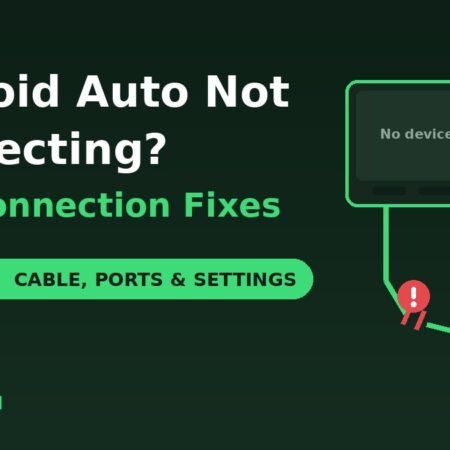

Quick Answer: When Android Auto won’t connect via USB, the cause is usually the cable — swap it for a data-rated cable under 1 meter (charge-only cables power the phone but carry no data). Then pull down the notification shade while plugged in, tap the USB settings notification, and select Data transfer / Android Auto instead of “Charging only”. Still nothing? Run Android Auto’s own test: Android Auto settings → Connection help → USB startup diagnostic — it tells you exactly which link is failing.
You plug your phone into the car, it starts charging — and that’s all it does. No Android Auto on the screen, no prompt on the phone, no navigation, no music. Just a charging icon and silence.
The USB chain has only a few links — cable, phone port, car port, phone settings, and the two apps at each end — which is good news: it makes this one of the more systematically fixable car-tech problems. Charging without connecting is the classic signature of a data problem, and the twelve fixes below run through the chain from most to least likely.
Where the Connection Breaks
| Symptom | Most Likely Cause | Jump to Fix |
|---|---|---|
| Phone charges but Android Auto never appears | Charge-only cable or wrong USB mode | Fix 1 & 3 |
| Worked before, suddenly stopped | Worn cable, or an app update broke it | Fix 1, 7 & 9 |
| Connects then drops repeatedly | Damaged cable or loose/dirty port | Fix 1 & 4 |
| Never worked in this car at all | Car on Rejected list, or head unit incompatible | Fix 5 & 10 |
| “Android Auto keeps stopping” errors | App cache or Google Play Services | Fix 9 |
| Works on cable, want to lose the cable | Not a fault — see wireless note | “Still Not Connecting?” |
How to Fix Android Auto USB Connection
Fix 1: Swap the USB Cable — the Right Kind
Cables cause more Android Auto failures than everything else combined. Two traps: charge-only cables (no data wires inside at all), and worn cables that still charge fine but drop data.- Use a cable explicitly rated for data transfer — ideally the one that shipped with your phone, or a USB-IF certified replacement.
- Keep it under 1 meter — Google’s own recommendation, because long cables lose signal integrity.
- Test the suspect cable by connecting your phone to a computer: if no file-transfer prompt appears, the cable can’t do data, case closed.
Fix 2: Run the Built-In USB Startup Diagnostic
Android Auto ships with its own connection tester that most people never discover — it checks the cable and handshake and names the failing step.- On the phone, open Settings → Connected devices → Connection preferences → Android Auto (or search “Android Auto” in Settings).
- Tap Connection help → USB startup diagnostic.
- Plug into the car when prompted and follow the test — it will tell you whether the cable, the port, or the car end is the problem.
Fix 3: Set the USB Mode to Data, Not Charging
Many phones default every USB connection to “Charging only” — which blocks Android Auto by design.- Plug into the car, then swipe down the notification shade.
- Tap the USB / Charging this device notification.
- Select File transfer / Android Auto / MTP — the wording varies by phone, but pick the data option, not charging.
Fix 4: Try Different Ports — and Clean Them
Both ends of the cable can betray you.- If the car has multiple USB ports, use the one marked with a smartphone or Android Auto icon — on many cars, only one port carries data and the rest are chargers.
- Shine a light into the phone’s port and gently remove pocket lint with a wooden toothpick — lint is the top cause of “connects when I wiggle it”.
- Push the cable fully home at both ends; half-seated plugs charge but drop data.
Fix 5: Check the Rejected Cars List
One mistaken tap on “Don’t allow” months ago, and your car sits on a blocklist forever.- Open Android Auto settings on the phone and tap Previously connected cars.
- If your car appears under Rejected cars, remove it.
- Make sure Add new cars to Android Auto is on for the first connection. (Oddly, some users find that turning it off after successful pairing makes reconnection more reliable — worth trying both ways.)
Fix 6: Restart Both Ends
The phone gets restarted often; the car’s infotainment system almost never does — and it runs software that hangs just like any computer.- Restart your phone.
- Turn the car fully off, open the door (this forces many head units to actually power down rather than sleep), wait a minute, and start again.
- Reconnect the cable only after both are fully booted.
Fix 7: Update the Three Pieces of Software
Android Auto breaks with version mismatches more than most apps, because three programs must agree: the Android Auto app, Google Play Services, and Android itself.- Update Android Auto in the Play Store. If updates are stuck, our Play Store apps not updating guide unsticks them.
- Update Android: Settings → System → Software update (wired Android Auto needs Android 9 or newer).
- Check the car maker’s site or dealer for a head unit firmware update — many “suddenly stopped working” cases trace back to car software.
Fix 8: Grant Every Permission Android Auto Asks For
Missing permissions can stop the startup silently.- Long-press the Android Auto icon (or find it in Settings → Apps) → Permissions.
- Allow Location, Microphone, Phone, Contacts, SMS, Notifications, and nearby-devices access where listed.
- Also confirm notifications for Android Auto aren’t blocked — the connection prompt arrives as a notification on some phones.
Fix 9: Clear Android Auto’s Cache (Then Data)
Corrupted app data is the usual culprit when Android Auto crashes on connection or shows “keeps stopping”.- Go to Settings → Apps → Android Auto → Storage & cache.
- Tap Clear cache, restart the phone, and test in the car.
- Still failing? Return and tap Clear storage — you’ll redo Android Auto’s first-run setup, which is quick. If Google Play Services itself is throwing errors, follow our Google Play Services keeps stopping guide — Android Auto cannot run without it.
Fix 10: Confirm the Car Actually Supports Android Auto
Worth ruling out on a car that has never connected.- Check your model and year on the manufacturer’s spec sheet or Google’s Android Auto compatibility list — many pre-2016 factory systems don’t support it at all.
- On some brands, Android Auto must be enabled in the head unit’s own settings menu before it will ever respond — check the car’s connectivity settings.
- No support? Aftermarket head units add Android Auto to almost any car.
Fix 11: Exempt Android Auto From Battery Optimization
Aggressive battery savers kill Android Auto’s background processes right when the car needs them.- Open Settings → Apps → Android Auto → Battery.
- Select Unrestricted (or turn off optimization for it).
- On Samsung, also check the app isn’t in “Sleeping apps” under Battery settings.
Fix 12: Forget Everything and Pair Fresh
When settings are tangled beyond diagnosis, a clean slate wins.- In Android Auto settings → Previously connected cars → Forget all cars.
- In phone Bluetooth settings, unpair the car too.
- On the head unit, delete the phone from its paired-device list.
- Plug in with your best cable and complete the setup prompts from scratch on both screens.
Still Not Connecting?
- Test with another phone or another car — thirty seconds with a friend’s phone splits the problem in half instantly: their phone works in your car → your phone is the issue; your phone works in their car → your car’s port or head unit is.
- Car USB port failing? Ports on the dashboard take years of plugging abuse. If every cable is loose in the car’s port, a dealer or car electrician can replace the USB module — often cheaper than expected.
- Consider going wireless. If your car supports wireless Android Auto (or with an inexpensive wireless adapter), you skip the cable entirely — it runs over Wi-Fi and Bluetooth instead. If the wireless connection is the flaky part, start with our Bluetooth keeps disconnecting guide.
- Crashes rather than connection failures? If Android Auto starts and then dies with errors, that’s app-side — clear data (Fix 9), and check whether a recent phone update coincided; rolling forward to the next app update usually resolves those waves.
More Android fixes on MozPK
- Phone not charging
- Android Bluetooth keeps disconnecting
- Google Play Services keeps stopping
- Play Store apps not updating
- Android battery draining fast after update
- App Fixes Hub
Frequently Asked Questions
Why does my phone charge in the car but Android Auto won’t start?
Charging needs only power wires; Android Auto needs data wires. A charge-only or damaged cable, a charge-only car port, or the phone’s USB mode set to “Charging only” all produce exactly this — charging works, data doesn’t.What cable does Android Auto need?
A data-transfer USB cable, ideally USB-IF certified and under 1 meter long. The cable that came with your phone is the safest choice; cheap long cables are the most common cause of failures and dropouts.Why did Android Auto suddenly stop connecting?
The three usual suspects: the cable finally wore out, an app or system update introduced a bug, or corrupted app data. Swap the cable, update Android Auto and Google Play Services, and clear the app’s cache — in that order.Does Android Auto work wirelessly?
Yes — on cars that support wireless Android Auto and phones running Android 11 or newer. For cars with wired-only support, plug-in wireless adapters convert the connection so your phone stays in your pocket.How do I run Android Auto’s connection diagnostic?
Open Android Auto settings on the phone → Connection help → USB startup diagnostic, then plug into the car and follow the test. It identifies whether the cable, port, or car end is failing.Related: Amazon Music Not Showing Playlists in Android Auto? 6 Fixes.