


Losing service after an iOS update is really two different problems wearing the same clothes, and the standard advice only fixes one of them. If you have already reset network settings twice and the problem keeps coming back after a few hours, you almost certainly have the second one — and no amount of toggling settings will fix it.
Check which you have before doing anything else. It takes five seconds.
Which problem do you actually have?
| What you see | What it is | Go to |
|---|---|---|
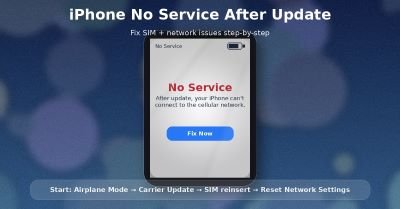
| No Service, Searching or SOS in the status bar, nothing else | A connection problem. Usually fixable in minutes | Part 1 |
| A red badge on the Settings app icon, and tapping it shows Cellular Issue Detected | A failed firmware update. Settings fixes will not resolve it | Part 2 |
The red badge is the deciding detail. If it is there, skip Part 1 entirely — those steps may restore service for a few hours, which is exactly what sends people round in circles for weeks.
Part 1: No Service, Searching or SOS
Work through these in order. The first two resolve the majority of cases after an update.
1. Airplane Mode for a full 15 seconds
Turn Airplane Mode on, wait at least fifteen seconds, then turn it off. Apple specifies the wait deliberately — a quick toggle reconnects to the same tower record that just failed, while a longer pause forces a fresh network registration.
2. Restart, then check for a Carrier Settings Update
Restart the iPhone. Then go to Settings → General → About and wait on that screen for around thirty seconds. If a carrier settings update is pending, a prompt appears on its own. This is the step most people skip, and after a major iOS release it is often the actual fix — the new iOS ships before the carrier profile that matches it.
3. Confirm the line is switched on
Go to Settings → Cellular and check your line is listed and enabled. Updates occasionally reset dual-SIM configurations, leaving the wrong line active or the primary line switched off. While you are there, confirm the line is set for both voice and data.
4. SIM: physical versus eSIM
With a physical SIM, eject the tray, check the card for dirt or damage, and reseat it firmly. With an eSIM there is nothing to reseat, and this is where updates cause more trouble: the profile can be left in a broken state. Do not delete an eSIM to reinstall it unless your carrier has confirmed they can reissue it — some carriers charge for this, and a few require a shop visit. Contact them first.
5. Reset Network Settings
Settings → General → Transfer or Reset iPhone → Reset → Reset Network Settings. This clears saved Wi-Fi passwords, VPN profiles and cellular configuration, and rebuilds the network stack. Have your Wi-Fi passwords to hand before you do it.
If service returns and then fails again within hours, stop and read Part 2. That specific pattern — temporary success followed by relapse — is the signature of the firmware problem, not a settings problem.
6. Check your carrier and your account
Before assuming the phone is at fault, confirm there is no local outage, that your account is active and in good standing, and that the line has not been suspended. Provisioning problems on the carrier side present exactly like a device fault. Testing your SIM in another phone settles it in one minute.
7. Install any pending iOS update
Apple frequently ships a point release specifically to fix cellular regressions introduced by a major version. Check Settings → General → Software Update before concluding the phone is broken.
Part 2: “Cellular Issue Detected” — the one everyone gets wrong
If a red badge sits on the Settings icon and the message inside says Cellular Issue Detected, this is not a configuration problem. According to Apple, it means the cellular communication features of the device failed to update correctly, and the result is that the phone cannot make calls, send texts, or use cellular data at all.
This is why the usual advice disappoints. Resetting network settings sometimes restores service briefly because it forces the modem to re-register, but the underlying firmware is still wrong, so the failure returns. People repeat the cycle for weeks and conclude their phone is dying.
What Apple actually prescribes
The documented fix is to reinstall iOS from a computer — not from the phone itself:
- Back up the iPhone first. This process can erase it if the first attempt fails.
- Connect it to a computer running the current version of macOS, iTunes, or the Apple Devices app.
- Open Finder on a recent Mac, or iTunes or Apple Devices on Windows, and select your device.
- Choose Update, not Restore. Update reinstalls iOS while keeping your data. Restore erases everything and should only be a fallback.
- If Update fails, restore from your backup afterwards.
On iPhones running iOS 18 or later, the Apple Support app can run additional diagnostics that help identify whether the cause is software or hardware, which is worth doing before booking a repair.
The related messages
Cellular Issue Detected has two siblings that appear the same way and are fixed the same way: Ultra Wideband Issue Detected, which affects precision finding features, and Apple Pay Issue Detected, which blocks Wallet payments until iOS is reinstalled. Seeing more than one at once points more firmly towards hardware.
When it is genuinely hardware
If reinstalling iOS does not clear the message, the modem itself is likely at fault and the phone needs service. Two signals make this more likely: the message returning immediately after a clean reinstall, and the phone having been dropped or exposed to moisture beforehand. An update did not break the modem, but it can be the point at which an already-failing one stops working.
What about SOS or SOS only?
SOS means the phone has no service from your own carrier but can still reach emergency services through another network. Diagnostically it is the same as No Service, so Part 1 applies. If it appeared immediately after an update and will not clear, the carrier settings update in step 2 is the most likely fix.
Frequently asked questions
Why did my iPhone lose service right after an iOS update?
Usually because the carrier settings profile has not caught up with the new iOS version. Waiting on Settings → General → About for thirty seconds prompts the update if one is pending, and that resolves most cases.
What does “Cellular Issue Detected” mean on iPhone?
It means the cellular firmware failed to update properly, so the phone cannot make calls, send texts or use mobile data. Apple’s documented fix is reinstalling iOS from a computer, not resetting settings on the phone.
Why does resetting network settings only fix it for a few hours?
Because a reset re-registers the modem without repairing the firmware underneath. Service returns until the next registration fails. That relapse pattern is the clearest sign you are dealing with the firmware issue rather than a configuration one.
Should I choose Update or Restore when reinstalling iOS?
Update first — it reinstalls iOS while keeping your data. Restore erases the phone completely and should only be used if Update fails, and only with a backup you have verified.
Should I delete and re-add my eSIM?
Only after speaking to your carrier. Deleting an eSIM removes it from the phone, and reissuing it is not always instant or free. A physical SIM can simply be reseated; an eSIM cannot.
Is No Service after an update a hardware problem?
Rarely on its own. It becomes likely if the Cellular Issue Detected message returns immediately after a clean iOS reinstall, or if more than one diagnostic message appears at the same time.
Related: SIM not detected on Android, Wi-Fi connected but no internet on iPhone, and Apple ID verification failed.